SAP S/4HANA Month-End Close: How to Get From 5 Days to 2
Most S/4HANA migrations fail to accelerate month-end close because the Universal Journal is activated incompletely and process redesign is treated as optional. The path from a 5-day ECC-era close to a 2-day S/4HANA close requires three sequential phases: activating the full Universal Journal stack, redesigning close tasks to eliminate ECC-era constraints, and deploying SAP Advanced Financial Closing for orchestration. Companies that rush to AFC without completing the first two phases end up running expensive tooling on inefficient processes.
Most companies that migrate to S/4HANA don't close faster. They spent the money, ran the project, went live — and six months later their Finance team is still taking five days to close. The system changed. The process didn't.
That's not a technology failure. It's an implementation failure, and it's more common than SAP's marketing numbers suggest. The Universal Journal gives you the structural capability to close in two days. Getting there requires full feature activation, a process redesign that stops treating S/4HANA like ECC, and — for the companies that achieve the best results — SAP Advanced Financial Closing. Most brownfield migrations don't do these things. Some don't even know they skipped them.
What the Universal Journal actually changes
If you're coming from ECC, your close process was built around tables. FI data lived in BKPF and BSEG. CO data lived in COEP. Asset accounting had ANEP. General ledger totals were in GLT0. Separate tables that required periodic reconciliation.
The Universal Journal (ACDOCA) eliminates this architecture entirely. Every financial document — FI, CO, asset, Material Ledger, profit centre — posts to a single line-item table in real time. No batch reconciliation between FI and CO because there's nothing to reconcile. The numbers are the same number, posted once.
That sounds technical. In practice, it's a process revolution. Every batch job you ran in ECC to move data between modules, to reconcile FI/CO differences, to roll up totals for period-end — those jobs are either eliminated or dramatically shortened. The bottlenecks that consumed days in ECC don't exist in the same form in S/4HANA.
The SAPinsider 2023 Financial Close Benchmark shows an industry average of eight calendar days to close. Top performers on S/4HANA close in one to three days. Dongming Petrochemical documented a three-day close post-migration.
These results are real. They're also not automatic.
The three failure modes
Most companies that don't achieve close acceleration after migrating hit the same patterns.
The first is running S/4HANA in ECC-compatibility mode. More common than most SI partners will tell you upfront. Brownfield migrations — by design — preserve your existing configuration to minimize risk. But that means many companies go live with S/4HANA's architecture and ECC's process model. Parallel ledger functionality isn't activated. New asset accounting isn't enabled. The Material Ledger is configured minimally to satisfy the mandatory requirement, not to capture its full capability. You get a system that runs faster and looks different in the UI, but your close process is essentially unchanged.
The second is skipping SAP Advanced Financial Closing. AFC is a separate licensed product running on SAP BTP. It enables parallel task execution across your close process, automated scheduling, real-time monitoring, and dependency management between close activities. Without it, you're still coordinating your close manually: email chains, spreadsheets, people calling each other to confirm the depreciation run finished before someone starts the cost center settlement. For companies targeting sub-three-day close, AFC is mandatory. The parallel execution it enables is where the final day or day-and-a-half comes from. The structural ACDOCA architecture gives you the base. AFC is what lets you exploit it.
The third is no process re-engineering. The close process you have in ECC was designed around ECC's constraints. Some tasks ran at period-end because they had to wait for batch jobs to complete. Some reconciliation steps existed because the data wasn't consistent in real time. In S/4HANA, those constraints are gone. But if your Finance team keeps running the close in the same sequence, with the same manual checkpoints, and the same "we always do it this way" logic, they'll keep taking the same number of days.
What full activation actually looks like
If you want the close results the case studies show, here's what needs to be activated and properly configured.
Universal Parallel Accounting. In S/4HANA, parallel ledgers (leading, local GAAP, IFRS) are handled natively without the reconciliation overhead of ECC. This requires proper ledger group configuration at implementation. If your brownfield migration mapped your ECC FI configuration directly without reviewing the ledger architecture, you may not be capturing the benefit.
New Asset Accounting. The old FI-AA architecture is deprecated in S/4HANA. New Asset Accounting integrates directly with the Universal Journal — every depreciation posting goes directly to ACDOCA. This eliminates the separate asset reconciliation from the traditional close. Migration from old to new asset accounting requires specific technical steps; some brownfield migrations defer it, leaving the old architecture in place.
Material Ledger — active and properly configured. Mandatory in S/4HANA Finance. But "mandatory and present" is different from "properly configured to support actual cost flow management." Material Ledger misconfiguration is an underrated cause of close delays. If the actual cost calculation runs long, or if period-end ML settlement is causing data inconsistencies, you have a bottleneck that looks like a system issue but is actually a configuration issue.
Cost Object Controlling aligned with the Universal Journal. In ECC, CO period-end processing — overhead allocation, activity rate calculations, settlement — was a sequence of batch jobs that had to run in strict order. In S/4HANA, the CO integration with ACDOCA means many of these calculations can run more fluidly, with real-time visibility into where costs are accumulating. But the configuration changes required to actually unlock this aren't always done in a standard brownfield migration.
The AFC case: when to invest in it
SAP Advanced Financial Closing costs money — it's a BTP subscription on top of your existing S/4HANA investment. For small or mid-market companies, the ROI case needs to be explicit.
The case is clearest in two scenarios: when your close involves multiple legal entities that need to coordinate (AFC's dependency management becomes critical here), and when you're targeting sub-two-day close and the structural ACDOCA changes alone won't get you there. For companies with complex group structures or high-volume transaction processing, the ROI is generally clear within 18–24 months.
For simpler structures — single legal entity, relatively low transaction volume, Finance team of under 10 — the math is harder, and the process redesign work will often deliver more than the tooling. Buying AFC to fix a process problem is expensive. Fix the process first.
The change management problem nobody models
I've watched this derail multiple S/4HANA Finance implementations: the Finance team keeps using the old transaction codes.
Not out of resistance — out of habit. They know FB50, they know MIGO, they know the ME21N sequence. S/4HANA has Fiori apps that replace these, but the underlying transactions often still work. So people use them. They don't adopt the new monitoring tools, the real-time close tracking, the embedded analytics dashboards. They print the same Excel reports they always printed.
Six months post-go-live, when the CFO asks why the close is still taking five days, the answer isn't in the technology.
The companies that cut close time significantly almost always have an explicit adoption program: transaction code mapping (old TXs to new Fiori equivalents), forced cutover to new tools for specific processes, and finance leadership that models the new behaviour rather than tolerating the old one. This is unsexy work. It doesn't appear in the implementation proposal. But it's often the difference between a system that was expensive to build and one that was expensive to build and actually works.
A realistic close reduction path
If you're starting from five to eight days and want to get to two to three, here is a rough phasing that works in practice.
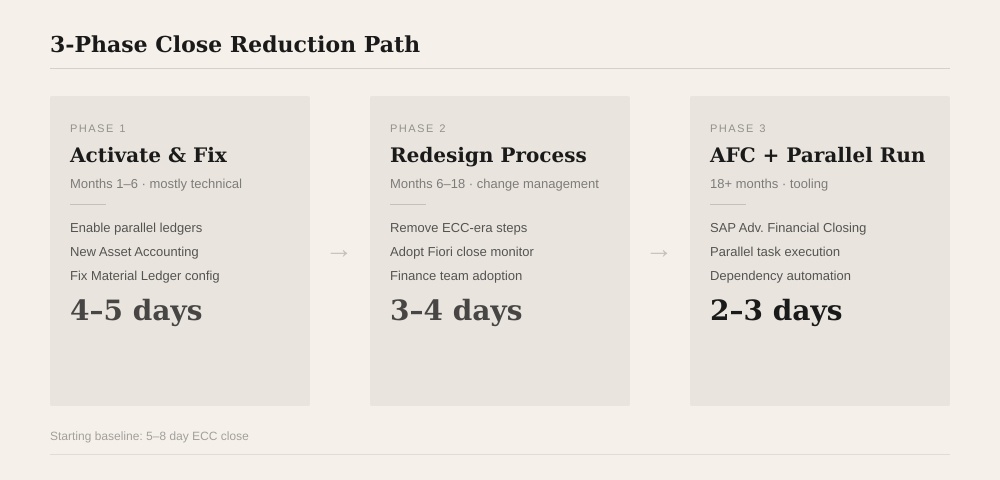 3-phase path: technical activation (months 1–6) → process redesign (months 6–18) → AFC + parallel execution (18+)
Months 1–6 post go-live: activate and clean up. Get full Universal Journal features active, fix Material Ledger configuration issues, complete the New Asset Accounting migration if it was deferred. Target: four to five days. Mostly technical.
Months 6–18: process redesign. Map every close activity against the new S/4HANA data model. Identify steps that existed only because of ECC limitations. Remove them or automate them. Introduce Fiori-based close monitoring. Target: three to four days. Mostly change management.
18+ months: AFC and parallel execution. If the ROI case supports AFC, implement it here, after the process redesign is complete. Parallel execution only helps when the tasks themselves are properly defined. Target: two to three days. Mostly tooling.
The companies that rush to AFC immediately after go-live, without doing the first two phases properly, end up with expensive tooling running inefficient processes faster. I've seen this exact pattern more than once. It's not the outcome they wanted.
You can close in two days. It requires activating what S/4HANA actually offers, redesigning your process to eliminate ECC-era constraints, and giving your Finance team enough time and support to genuinely adopt the new way of working.
Hard work. Takes longer than the implementation project. Completely worth it, and not just for the days recovered. A real-time close changes how Finance participates in actual business decisions, not just reports on them after the fact.
Frequently asked
Why doesn't migrating to SAP S/4HANA automatically speed up month-end close?
Because close acceleration requires three things beyond go-live: full Universal Journal activation (many brownfield migrations leave legacy ledger structures partially in place), process redesign to eliminate ECC-era sequential constraints, and — optionally — SAP Advanced Financial Closing for orchestration. Most migrations deliver the technology without the process work, so the Finance team runs the same 5-day process on a faster system.
What is the Universal Journal and why does it matter for close speed?
The Universal Journal is S/4HANA's single-table financial data model. It eliminates the reconciliation runs between FI and CO that were mandatory in ECC, enables real-time financial position visibility, and allows parallel close tasks that were previously sequential. Full activation means migrating all FI-CO reconciliation objects and deactivating legacy document splitting — steps that brownfield migrations often skip to reduce go-live risk.
How long does it take to get from a 5-day to a 2-day close in S/4HANA?
Typically 6-18 months post-go-live for organizations that commit to all three phases. Phase 1 (Universal Journal full activation) takes 1-3 months. Phase 2 (process redesign with the Finance team) is the longest — 3-9 months depending on organization complexity and change management. Phase 3 (AFC deployment) adds 2-3 months. Companies that measure from go-live to a stable 2-day close typically land between 9-18 months.
Need this in your organisation?
I work with a small number of clients each quarter on ERP strategy and IT-department automation. If the questions raised above are live in your team, get in touch.
Start a conversation →